
April 2026
Wendy Schneider
For many Jews of my generation, Poland is synonymous with concentration camps, antisemitism, and the Holocaust. But a recent visit to Warsaw’s POLIN Museum of the History of Polish Jews offered a far more nuanced understanding of a thousand-year relationship that has understandedly been eclipsed by the Holocaust. I first heard about POLIN from its original curator, the brilliant Canadian-born scholar Barbara Kirshenblatt-Gimblett, who delivered the keynote Goldblatt Lecture at McMaster University, a Jewish Studies series endowed by my family shortly after the museum’s official opening in 2014. Her presentation left a deep impression and I remember thinking then that I had to see this place for myself. So when an opportunity finally arose this past January, I seized it.
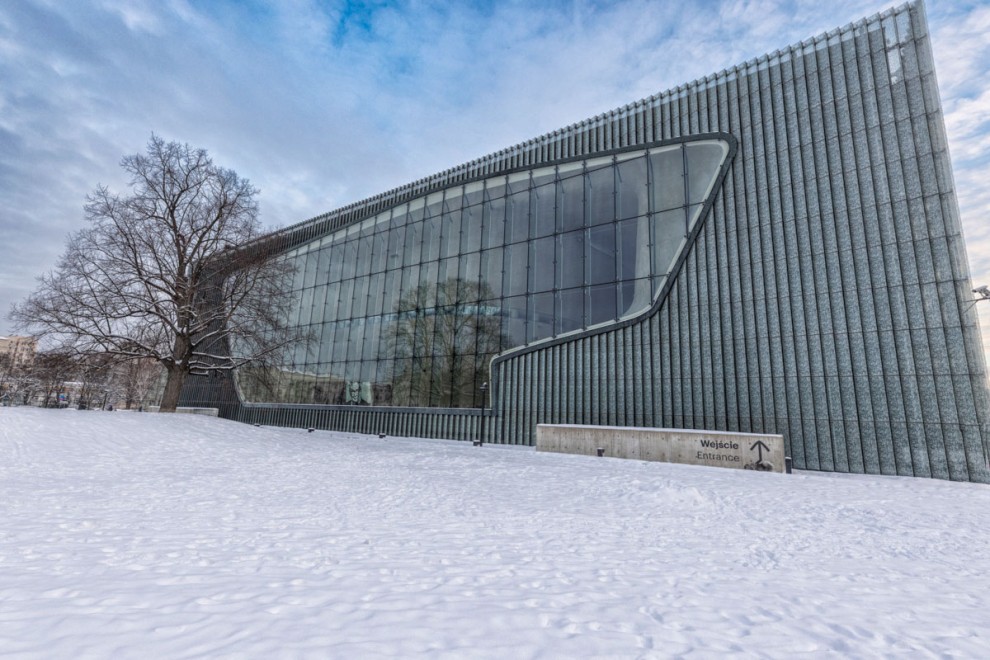
The POLIN Museum, 20 years in the making, is an extraordinary public–private partnership between the Association of the Jewish Historical Institute of Poland, the City of Warsaw, and Poland’s Ministry of Culture and National Heritage. Its striking contemporary building stands on what Kirshenblatt-Gimblett has called a “site of conscience”: the rubble of the former Warsaw Ghetto.
Yet POLIN is not a museum of the Holocaust. Its mandate is broader and more ambitious — to tell the story of a thousand years of continuous Jewish presence in a land to which most Ashkenazi Jews today can trace their roots. Across eight thematically organized galleries, POLIN charts both the peaks and valleys of a place that was once home to the world’s largest Jewish community.
As a North American diaspora Jew navigating the post–Oct. 7 world, the story told here struck me with particular force. It reflects the sweeping arc of Jewish history—flourishing communities, devastating loss, and the remarkable resilience that allows Jewish life to begin again. That is why I believe a visit to the POLIN Museum is essential for Jews everywhere.
From the museum’s light filled spacious lobby, the visitor descends a flight of stairs into a virtual forest evoking a rabbinic legend about the first Jews to arrive in Poland hearing the Hebrew words “Po Lin”—“Rest Here”—a mystical promise of refuge from persecution and future prosperity. The path then leads into the medieval gallery, which traces six centuries of history, from 965—the earliest recorded account by a Jewish traveler from Córdoba—to 1507, when Poland had become the heart of the Ashkenazi world.
The next gallery, aptly titled Paradisus Iudaeorum—“Jewish paradise”—chronicles a golden age for both Jews and Poles that spanned roughly 226 years, from the mid-seventeenth to the late eighteenth century. The Polish–Lithuanian Commonwealth, then Europe’s largest country, stretched across what is today Poland, Lithuania, Belarus, Ukraine, and parts of the Baltic region. Under the protection of the Polish nobility, Jews prospered economically, flourished culturally, and enjoyed an unprecedented degree of communal autonomy.
The centrepiece of this gallery—and the museum’s most photographed feature—is the breathtaking reconstruction of the painted ceiling of the Gwodziec synagogue, one of hundreds of wooden synagogues destroyed by the Nazis. Its recreation took a decade of work by historians, craftspeople, and volunteers.
Yet this golden age carried a darker undercurrent, powerfully evoked in the exhibit’s “Corridor of Fire.” Protected by the ruling elite but resented by the peasantry, Jews occupied a precarious social position. That tension erupted in the 1648 Chmielnicki Uprising, a Cossack-led revolt fueled by peasant rage that unleashed devastating violence. Entire Jewish communities across what is now Poland, Belarus, and Ukraine were destroyed, marking one of the defining traumas of modern Jewish history.
Jewish and Polish histories converge again in the next gallery, which opens with the late-eighteenth-century dissolution of the Polish–Lithuanian Commonwealth. Its territories were partitioned among Russia, Prussia, and Austria, erasing Poland—and with it, Belarus, Ukraine, and Lithuania—from the political map of Europe for more than a century. Jews suddenly found themselves largely confined to two regions: the Russian-controlled Pale of Settlement and Austrian Galicia. The exhibition traces how this upheaval gave rise to new political and social movements as Jews grappled with modernity. The Jewish Enlightenment movement promoted secular education and cultural integration, while Hasidism emerged as a mystical, populist movement that challenged rabbinic authority and offered spiritual solace amid recurring waves of anti-Jewish violence.
Poland regained its independence in 1918, following the end of the First World War, only to face renewed catastrophe two decades later, when Nazi Germany and the Soviet Union carved up its territory in 1939. The interwar years are captured in one of POLIN’s most vivid sections, titled “On the Jewish Street,” which evokes a second—if tragically brief—golden age for Polish Jewry.
During this period, Yiddish culture flourished. Literary giants such as I. L. Peretz and Sholem Aleichem were widely read, Yiddish films drew large audiences, and Yiddish tango filled Warsaw’s cabarets. The dynamism of Jewish public life is powerfully conveyed through a display of newspapers published in Yiddish, Hebrew, and Polish.
It was also an era of intense political debate and activism. Visitors learn about the origins of the Zionist movement—which I found particularly resonant amid today’s misinformation—as well as the Jewish labour movement, the Bund, and Agudath Israel, an Orthodox political party that sought to unite Hasidic and non-Hasidic Jews in opposition to secularism and Zionism. Together, these movements reveal a community grappling with modernity, identity, and the pressures of persistent antisemitism.
A photograph of American embassy staff in Warsaw looking up as Nazi bombs fall over Warsaw on Sept. 1, 1939 stands at the entrance to the museum’s Holocaust section, which is presented through the perspectives of two individuals central to the Warsaw Ghetto. On the left, we find the story of the Polish Jewish historian Emanuel Ringelblum, creator of the clandestine archive Oyneg Shabes that documents everyday life under Nazi rule. On the opposite wall, a parallel narrative traces the tragic experience of Adam Czerniaków, head of the Warsaw Ghetto Judenrat, whose futile efforts to negotiate with the Nazis ended with his suicide in July 1942. The section also confronts the complexity of Polish–Jewish relations during the war, juxtaposing stories of betrayal with accounts of those who tried to rescue Jews—and who, in some cases, shared their fate.
The Holocaust wiped out 90 percent of Poland’s 3.3 million Jews, a tragic, irrevocable rupture many believed marked the final chapter of Polish Jewish history. Yet POLIN’s postwar gallery reveals a lesser-known story that testifies to the power of memory, survival, and the resilience of the Jewish people.
The story begins with survivors of concentration camps and Soviet gulags returning to their hometowns, only to face violent pogroms stoked by blood libel rumours and disputes over stolen property. In the aftermath, more than half of Poland’s roughly 350,000 pre-war Jews left the country. A significant number of those who remained rose to prominence in the communist regime—until the Soviet-orchestrated anti-Zionist and antisemitic purge of March 1968 forced another 13,000 to leave.
With the fall of communism in 1989, Jewish life in Poland began an unexpected revival, symbolized by the founding of POLIN. The museum’s narrative concludes with a video installation featuring interviews with 20 Jews living in Poland today, whose reflections on identity, belonging, and the possibility of a Jewish future in the country offer a hopeful conclusion.
The average visitor spends about two hours in POLIN’s core exhibition; I spent four—and could easily have spent another day. Barbara Kirshenblatt-Gimblett highlights its high rate of return visits, popularity with schoolchildren, and the many visitors who say it conveys not just Jewish, but Polish history.
POLIN has weathered political storms—under the previous government, then-director Dariusz Stola was accused of “politicizing” the museum—but today it enjoys broader support. At its core, the museum challenges Polish visitors to consider whether their history is a story of heroism and victimhood, or one that also acknowledges moral gray zones and complicity.
By embracing complexity, POLIN is more than a museum: it is a place where history is not only learned, but felt, wrestled with, and returned to again and again.
FEATURED PHOTO GALLERY: A selection of images from the POLIN Museum of the History of Polish Jews
