April 2026
Wendy Schneider
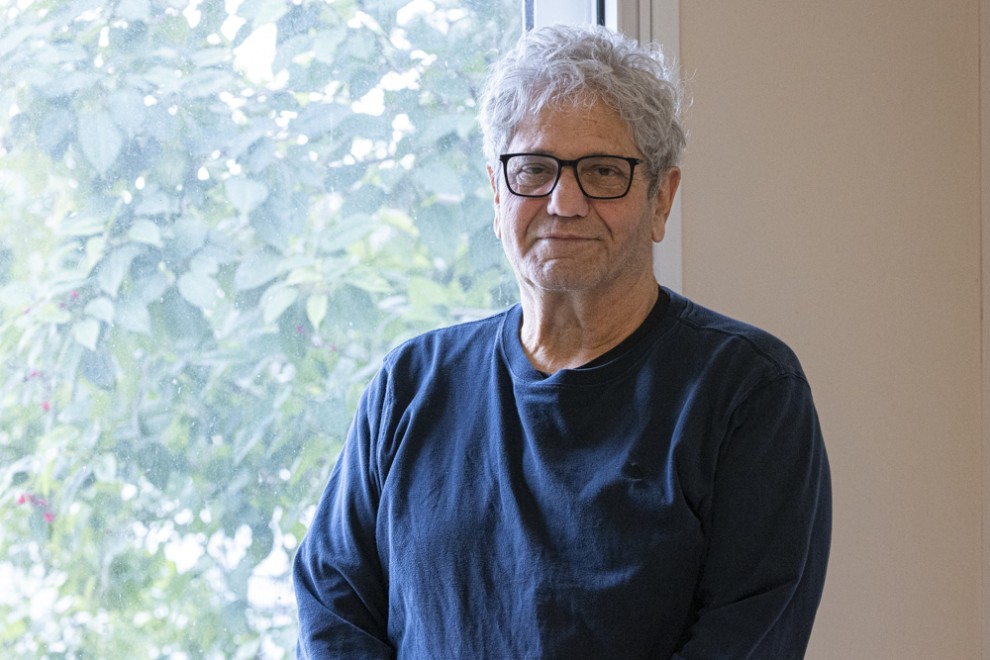
Shuli Dichter can no longer bear to watch the sunrise. Before Oct.7, 2023, the veteran Israeli civil society activist would rise before dawn and sit on the porch of his home on Kibbutz Ma’anit, quietly witnessing the day begin. But that morning changed everything. In the final minutes before his friend, Canadian-Israeli peace activist Vivian Silver, was murdered, he had been following her updates on a group WhatsApp chat, until she suddenly went silent. Since then, he has abandoned the ritual. The sunrise, once a source of calm, has become a painful reminder.
Dichter, whom I have known for many years, is a prominent voice in Israel’s civil society circles. When my daughter and I visited Israel recently — my first trip since the Oct. 7 attacks — we stopped to see him while reconnecting with friends in the country’s north. I wanted to understand how the events of that day had shaped him, both personally and politically.
Our conversation began with me telling Dichter how deeply unsettled I was to see prominent left-wing Israeli intellectuals — such as the historian Ilan Pappé, journalist Gideon Levy, and former Knesset member Avraham Burg — aligning with international critics who portray Zionism as inherently racist, a form of settler-colonialism, and the root of the Israeli-Palestinian conflict.
Did Dichter, I asked, still see himself as a Zionist?
“Yes,” he said without hesitation. “But a civic Zionist. Once you declare yourself an anti-Zionist, you absolve yourself of responsibility for improving this society.”
Shirking responsibility is not in Dichter’s DNA. For more than five decades, he has held senior positions in Israel’s leading advocacy NGOs, working to secure full citizenship rights for both Jewish and Arab citizens. In his political memoir, Sharing the Promised Land (English translation, 2022), Dichter lays out his vision of “civic Zionism”: a democratic Jewish state that fulfills its founders’ promise of full social and political equality for Arab citizens.
Dichter’s story is deeply personal. He recalls growing up as a first-generation kibbutznik, drawn early on to coexistence projects with Arab neighbours. But over time, he became increasingly aware of the discriminatory nature of state policies that concentrated land, funding, and political power in Jewish hands, leaving Arab citizens underfunded, politically marginalized, and subject to systemic discrimination.
“It did not have to be that way,” he told us, pointing to the early Zionist thinker Yitzhak Epstein, who warned that displacing Arab farmers during land acquisitions and pursuing a Jewish national project without regard for Arab aspirations was both ethically wrong and destined to sow future conflict.
And yet, despite Dichter’s harsh critique of Zionism’s shortcomings, he remains steadfast in his belief in the Jewish people’s right to self-determination in the Land of Israel. “This is our land,” he said. “We belong here, but they also belong here. So we will have to share this promised land.”
By “sharing the promised land,” he does not mean the “one-state solution,” which calls for a single bi-national state for Jews and Palestinians. Rather, he envisions a confederation of two distinct nations coexisting in a shared homeland, modeled on arrangements in Northern Ireland, Belgium, Switzerland, and Quebec. Roughly seven million Jews and seven million Palestinians live between the Jordan River and the Mediterranean Sea, he said. Neither is leaving; neither is disappearing. The challenge, he insists, is not to deny that reality but to restructure it.
As our conversation shifted from the political realm to the personal, the weight of the past two and a half years became unmistakably clear. His eyes welled briefly when I asked how he was holding up.
“Israel is in deep, deep trouble,” he said.
Yet his deeper worry is for diaspora Jews, whom he calls “twice troubled”: first by a resurgence of antisemitism, and second by the way Israel has become a wedge issue dividing unconditional supporters, anti-Zionists, and those caught in between.
He experienced that tension personally last year when a synagogue in the United States — where one of his daughters and several grandchildren live — disinvited him after learning of his opposition to Israel’s prolonged military campaign in Gaza. His objection, he said, was interpreted as a denial of Israel’s right to self-defense.
What unsettled him most was not the cancellation itself, but the narrowing of the room.
“The entire basis for my concept of civic Zionism relies on the diaspora virtue of inclusivity,” he told me, invoking the Jewish tradition of sustaining multiple, contradictory, viewpoints. “You can agree or disagree. But if you don’t let both into the room, you’re doomed.”
Dichter lives that principle. His weekly study partner is a rabbi from a West Bank settlement, a testament to his belief in dialogue across divides. Nor have the events of October 7 and their aftermath deterred him from his current project: a multi-volume lexicon, co-edited with Haifa-based legal scholar Dr. Amir Fakhoury, designed to give Jewish and Arab civil society activists the language to turn ideals into action.
At a time when Israel faces growing isolation on the world stage, Dichter’s embrace of Zionism’s loftiest ideals, combined with his unwavering commitment to a more just and equitable society, strikes me as profoundly courageous. In an era defined by polarization, he has chosen the far harder path: to remain in the conversation, even when it is painful. He may no longer watch the sunrise, but he refuses to surrender to the darkness.
